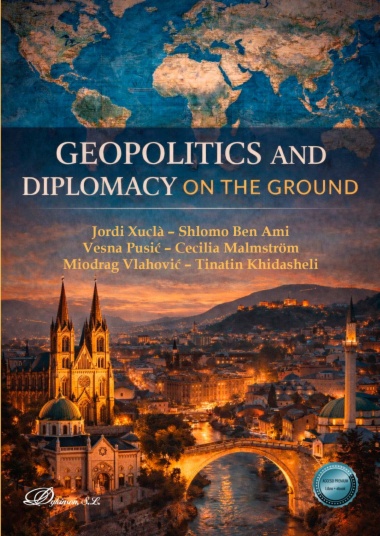
In an impatient and reconfiguring world, diplomacy reveals its best face: the exercise of dialogue, reason, and negotiation as pathways to resolve conflicts and build the future. This book brings together the reflections and experiences of Shlomo Ben Ami, Vesna Pusié, Cecilia Malmstrom, J ordi Xucla, Miodrag Vlahovié and Tinatin Khidasheli, figures who have negotiated, shaped and lived power through their diplomatic, ministerial, parliamentary and academic responsibilities.From their own trajectories, the authors explore international action on the ground, where political decisions meet human and geopolitical complexity.Shlomo Ben Ami bears witness to his study of international relations and the practice of diplomacy, also analysing the Middle East conflict. Vesna Pusié proposes a new project of democracy, revisiting the peace finally achieved in the Balkans and Croatia's entry into the European project. Cecilia Malmstrom examines the expansion and readjustment of the liberal democratic project in an interdependent world. Jordi Xucla observes the Balkans and the South Caucasus as new laboratories of Euro pean integration and stability. Miodrag Vlahovié recounts the patient construction of Montenegro's independence and international recognition. Tinatin Khidasheli presents Georgia's European vocation as a rational and strategic choice.These pages combine memory and strategy, moral commitment and political realism. Geopolitics and Diplomacy on the Ground is not merely a treatise on international relations; it is an invitation to think about the future through experience, with the serenity of those who have learned that peace is not imposed but built.
- Cover
- Title page
- Copyright page
- Table of Contents
- The age of invisible wars, Jordi Xuclà
- The value of diplomacy, Shlomo Ben Ami
- P.S. The anti-Diplomacy
- Politics and responsibility: The New democracy project, Vesna Pusic
- To lessons of war
- Serbs and Croats
- Old Bridge of Mostar
- Autocracy with a democratic legitimacy
- Can europe lead?
- New democracy project
- Strategic Cornerstones
- Purpose
- Passion
- Conviction
- Coordination
- Tactical tools
- The uses of adversity
- Learning from success
- Learning from the enemy
- The long game
- Education
- Reducing the wealth gap
- Politics and Responsibility: Reflections on Liberalism and Globalization, Cecilia malmström
- Editor’s note
- An optimistic liberal vision on 2007
- Eighteen years later
- Laboratories of Integration at Europe’s Brders: From the Balkans to the Caucasus, Jordi xuclà
- Introduction
- The karabakh mediation: Between paralysis and peace (2011–2025)
- The collapse of illusions: From globalization of democracy to the return of power politics
- The end of the “post-soviet space” and armenia’s journey beyond it
- Ukraine and the impossible geometry of “the two houses”
- Azerbaijan: A rapid disconnection from moscow
- The Western Balkans: From Frontier to European Promise
- Memories of a Divided Continent
- A Larger Europe, or a Deeper One?
- Karabakh: From Frozen Conflict to Legal Settlement
- Historical Background to the Karabakh Conflict
- The Soviet Construction of the NKAO
- From Glasnost to Reintegration: The Evolution of the Karabakh Conflict (1988–2024)
- Uti Possidetis Iuris and the 2025 Peace Settlement
- Information warfare and strategic narratives in the 2020, Karabakh Conflict
- The War of Narratives: Meaning and Visibility in the Karabakh Conflict
- Armenia’s Communication Strategy
- Azerbaijan’s Communication Strategy
- Digital and Visual Diplomacy and Comparative Analysis
- Uti possidetis juris and the formation of post-soviet borders
- The Roots of Uti possidetis juris
- The Post-Soviet Space and the Legal Default
- Karabakh as a Test Case of Uti possidetis juris
- Exception and Norm: Kosovo and Karabakh
- Conclusions
- References
- A Diplomatic Necessity for Radical Patience, Miodrag Vlahovic
- Prologue
- Context
- Biographical Reflections and the Western Balkans’ Dilemmas
- Challenges, Dilemmas of Montenegro and the Western Balkans
- Institutional Fragility and Democratic Challenges
- Nationalism and Populism in Montenegro and the Western Balkans
- The Unfinished European Journey: Montenegro’s Struggle for Accession
- Between (good & malign) giants: The geopolitics of montenegro in a contested region
- Flags, Papers and Promises: A Diplomat’s Chronicle Of Birth
Of A State
- Beyond Independence: Building Security, Facing Doubt
- Montenegro and the Atlantic Alliance
- At the core and the periphery: An ambassador’s service in Washington, Ottawa, and Reykjavik
- A Letter to European Friend
- Facing the Challenges of the Past
- Return to budapest
- Secretary hegseth’s russian tie
- Budapest: Negotiations or performance?
- Montenegrin Diplomacy at the Time of Restoration of Independence: Main details
- References
- Anchored in europe: Georgia’s strategic choice in a fragmented world. Why georgia’s european perspective is a rational strategy, Tinatin Khidasheli
- Introduction: Europe as a strategic horizon
- Small-State Strategy and the Strategic Value of Europeanization
- Europeanization as Embedded Deterrence and Economic Transformation
- The Limits of Europeanization: Elite Capture and Symbolic Reform
- The european neighborhood policy: Scope, Evolution, and
georgia’s place
- The Evolution of the European Neighborhood Policy and Georgia’s Experience
- Evolving dynamics of eu–georgia cooperation
- Reversibility of europeanization and the lessons of georgia
- Europe’s Strategic Reawakening: Competing Neighborhoods, Russia, and Black Sea Security
- Civilian Missions, Strategic Awakening, and the Black Sea Dimension
- The South Caucasus and the Fragmented Order: Georgia’s Regional Role
- Conclusion: Re-anchoring through Reform and Resilience
- References

 Texto
Texto
 Audio
Audio
 Adobe DRM


 Ingrese a su cuenta