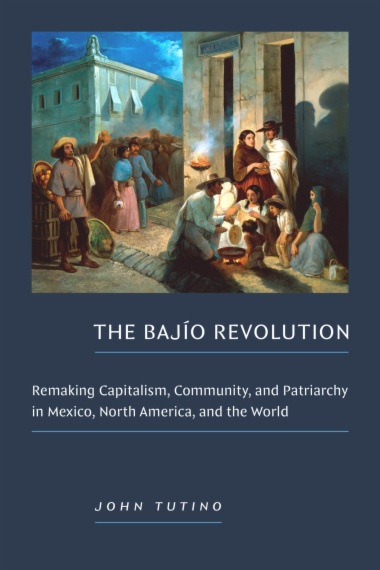
In The Bajío Revolution, John Tutino examines how popular insurgents reshaped Mexico, the United States, and global capitalism during the nineteenth century. After detailing New Spain’s silver-driven wealth, Tutino shows how the Bajío insurgency of 1810–20 broke silver flows and Asian trades, opening markets to industrial cloth made in England from cotton made by enslaved hands in the US South—while Bajío women claimed pivotal roles making maize to sustain families and guerrilla bands. As Mexico gained independence in 1821, mining remained broken while family growers held strong. Then, in the 1830s, a new silver-industrial capitalism fed by family maize makers rose in the Bajío. Women still led rural families and took on mill labor; one woman became Mexico’s leading silver capitalist. Facing that competition, in the 1840s the United States invaded to claim Texas for cotton and slavery and California for gold. The new Mexican capitalism carried on until the United States mobilized gold taken in war to join a global gold standard in the 1870s—blocking Mexico’s independent route to capitalism.
- Cover
- Contents
- List of Illustrations
- Prologue. Between Silver and Maize: New Spain and Mexico in the World, 1550–1880
- Introduction. The Revolution(s) That Remade Global Capitalism
- Part I: Making Silver Capitalism, 1500–1810
- 1. A New World in the Bajío: Silver, Capitalism and Patriarchy, 1550–1760
- 2. Shaking the New World: Global Wars, Capitalist Predations, Imperial Crises, 1760–1810
- Part II: Breaking Silver Capitalism, 1810–1820
- 3. The Hidalgo Revolt: Four Months That Shook New Spain
- 4. Insurgent Guanajuato: Claiming Maize Making Community, Breaking Silver Capitalism, Rattling Patriarchy
- 5. Counterinsurgency Capitalism in Querétaro Production, Patriarchy, and the End of Profit at La Griega
- 6. New Spain in the Time of Revolution: Arming Power, Defending Property, Conceding Family Production
- Part III: Seeking Mexico, 1820–1830
- 7. As the World Turned: Imperial Dreams, Capital Failures, National Challenges
- 8. Independent Guanajuato: Strong Communities Strong Women, Independent Cultures
- 9. Querétaro After Insurgency: Agrarian Capitalism Falls, Families Claim Maize—and More
- 10. Mexico in the Wake of Revolution: Oligarchs Fall Women Press On, Families Make Maize—and More
- Part IV: Making Silver-Industrial Capitalism, 1830–1860
- 11. A New Bajío, 1830–1845: Silver Revives, Industry Rises Landlords Struggle—and Family Growers Carry Everything
- 12. A New Capitalism, 1845–1860: Silver Peaks, Industry Expands, Rancheros Thrive—and Family Growers Feed Everyone
- Conclusion. Breaking the New Bajío: US Imperialism Liberal Assertions, French Invasion—and a Cross of Gold, 1845–1880
- Epilogue. Mexico Since 1875: Silver Gone, Families Carry On—Until Globalizing Capital Claimed Maize
- Acknowledgments
- Appendix A. Querétaro Population, 1778–1854
- Appendix B. Silver and Mining, 1810–1870
- Appendix C. Production and Population, at Querétaro Estates, 1791–1826
- Appendix D. Production and Work at Querétaro, 1840–1854
- Appendix E. Mexican Population, Production, Trade, Revenue, and Debt, ca. 1861
- Appendix F. Population and Production in Guanajuato, 1855–1876
- Appendix G. The Bajío in Mexico, 1876–1895
- Notes
- Bibliography
- Index
- A
- B
- C
- D
- E
- F
- G
- H
- I
- J
- L
- M
- N
- O
- P
- Q
- R
- S
- T
- U
- V
- W
- X
- Y
- Z



 Ingrese a su cuenta
