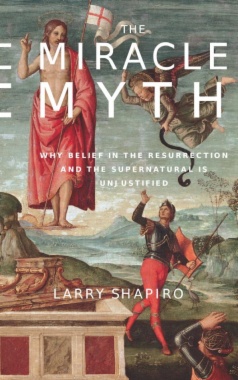
There are many who believe Moses parted the Red Sea and Jesus came back from the dead. Others are certain that exorcisms occur, ghosts haunt attics, and the blessed can cure the terminally ill. Though miracles are immensely improbable, people have embraced them for millennia, seeing in them proof of a supernatural world that resists scientific explanation.
Helping us to think more critically about our belief in the improbable, The Miracle Myth casts a skeptical eye on attempts to justify belief in the supernatural, laying bare the fallacies that such attempts commit. Through arguments and accessible analysis, Larry Shapiro sharpens our critical faculties so we become less susceptible to tales of myths and miracles and learn how, ultimately, to evaluate claims regarding vastly improbable events on our own. Shapiro acknowledges that belief in miracles could be harmless, but cautions against allowing such beliefs to guide how we live our lives. His investigation reminds us of the importance of evidence and rational thinking as we explore the unknown.
- Contents
- A Note on Style
- Acknowledgments
- Abbreviations
- Introduction
- I. African Worlds, African Voices
- “A Story Is Like the Wind” and “The Sun Is Thrown into the Sky,” //Kabbo
- On God and Ancestors, Ndukwana kaMbengwana
- The Black People and Whence They Came, Magema M. Fuze
- Mhudi, Solomon T. Plaatje
- II. Colonial Settlement, Slavery, and Peonage
- An African Woman at the Cape: Krotoa (c. 1642–74), Julia C. Wells
- The Necessity of Slavery, W. S. van Ryneveld
- A Rebel Slave, Galant
- Unconfessed, Yvette Christiansë
- Bobotie Recipe, Clifton Crais
- The Subjugation of the Eastern Cape Khoekhoe, John Barrow
- The Treatment of Indentured Laborers, R. J. van der Riet
- Protesting the Vagrancy Ordinance, Various
- Manifesto, Piet Retief
- The History of the Afrikaans People, C. P. Bezuidenhout
- Biltong Recipe, Clifton Crais
- III. Frontiers
- Among the Xhosa in 1800, Johannes Theodorus van der Kemp
- The Problem of God, Robert Moffat
- Visit to a Mission Community in Natal, John William Colenso
- Nkosi Sikelel’ iAfrika (God Bless Africa), Enoch Sontonga and Samuel E. Mqhayi
- Dingane’s Killing of Retief, F. Owen
- Mpande Seeks an Alliance with the Boers in Natal, Volksraad of the Republic of Natalia
- Statement of the Prophetess Nonkosi, 23rd October 1857, Nonkosi
- Heart of Redness, Zakes Mda
- IV. All That Glitters
- The Story of the Diamond Fields, Anthony Trollope
- The Trial of Langalibalele, British Parliamentary Papers
- The Coming of the Anglo-Zulu War, Cetshwayo kaMpande
- Industrial Johannesburg, Violet Markham
- A Model Compound Manager, Douglas Blackburn
- Building a Nation from Words, Isabel Hofmeyr
- A Century of Wrong, Francis William Reitz
- A Boer Commando, Deneys Reitz
- Concentration Camps, Emily Hobhouse
- Africans in the South African War, S. M. Molema
- V. United and Divided
- The 1913 Natives’ Land Act, Solomon T. Plaatje
- Bhambatha Rebellion, Msime ka Beje
- The Bulhoek Massacre, Anonymous
- Mine Workers’ Songs, Mphafu and Majara Majara
- Women’s Labour, Olive Schreiner
- Workers of the World, Unite and Fight for a White South Africa, William Urquhart
- The Persecution of Indians, Mohandas K. Gandhi
- The Journey to Pretoria, Naboth Mokgatle
- Township Life, Marabastad, Pretoria, Es’kia Mphahlele
- Special Section: Everyday Life in Soweto: The Photography of Santu Mofokeng, Patricia Hayes
- VI. Apartheid and the Struggle for Freedom
- Requiem for Sophiatown, Can Themba
- Mr. Drum Goes to Jail, Henry Nxumalo
- Repeal the Pass Laws!, ANC Women’s League and the Federation of South African Women
- Programme of Action, ANC Youth League
- Women’s Charter, Federation of South African Women
- My Spirit Is Not Banned, Frances Baard and Barbie Schreiner
- Freedom Charter, Congress of the People
- The Manifesto of Paramount Chief K. D. Matanzima, 1963, K. D. Matanzima
- The Peasants’ Revolt, Govan Mbeki
- The Discarded People, Cosmas Desmond
- The Pan Africanist Congress, R. M. Sobukwe
- Statement from the Dock, Nelson Mandela
- VII. From Soweto to Liberation
- White Racism and Black Consciousness, Steven Biko
- Reporting from Soweto, 17 June 1976, Nat Serache and Derrick Thema
- Students and the Soweto Uprising, Khotso Seatlholo
- The United Democratic Front, Allan Boesak
- Sanctions and the Armed Struggle, Oliver Tambo
- The Church and the Struggle, Desmond Tutu
- Crossing the Rubicon, P. W. Botha
- Never Give In, Andries Treurnicht
- The Future of South Africa, Mangosuthu Gatsha Buthelezi
- Violent Times, Emma Mashinini
- The Funeral of ANC Guerrilla Thanduxolo Mbethe, Anonymous
- Struggle Songs, Various
- “Reforms” and Revolution in South Africa, Joe Slovo
- Politics and Violence, Rian Malan
- Preparing Ourselves for Freedom, Albie Sachs
- Release from Prison, Nelson Mandela
- White Referendum, F. W. de Klerk
- Record of Understanding, F. W. de Klerk and Nelson Mandela
- Inaugural Address, Nelson Mandela
- VIII. Transitions and Reconciliations
- I Am an African, Thabo Mbeki
- Mass Struggle, Negotiations, and the 1994 Elections, Alex Callinicos
- The Rape of Women, Antjie Krog
- The Cradock Four, Testimony from the Truth and Reconciliation Commission
- Amnesty or Impunity?, Mahmood Mamdani
- Repeal the Black Authorities Act, Rural People’s Movement
- The Myth of Timeless Africa in the Game Parks, Shirley Brooks
- AIDS and Poverty, Thabo Mbeki
- Global Day of Action, Treatment Action Campaign
- Zuma’s Rape Trial, Steven Robins
- Lessons Learned, Bafana Khumalo and Dean Peacock
- Murder of Noxola Nogwaza, Ekurhuleni Pride Organizing Committee
- Ghosts of Sara Baartman, Clifton Crais and Pamela Scully
- David’s Story, Zoe Wicomb
- Witchcraft in Soweto, Adam Ashforth
- Nationalize the Mines, Julius Malema
- Xenophobic Violence, Nathan Geffen
- Welcome to Our Hillbrow, Phaswane Mpe
- The World Cup, Christopher Merrett
- Glossary
- Suggestions for Further Reading
- Acknowledgment of Copyrights and Sources
- Index

 Texto
Texto
 Audio
Audio
 Adobe DRM


 Ingrese a su cuenta