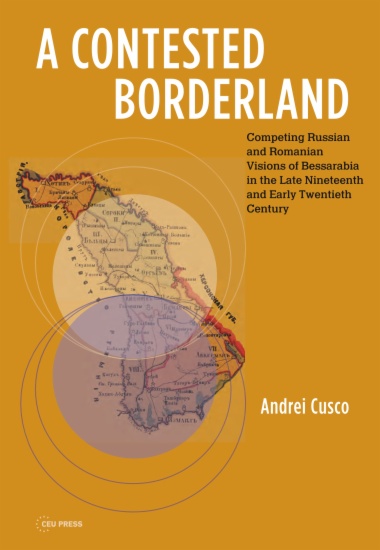
Bessarabia¿mostly occupied by modern-day republic of Moldova¿was the only territory representing an object of rivalry and symbolic competition between the Russian Empire and a fully crystallized nation-state: the Kingdom of Romania. This book is an intellectual prehistory of the Bessarabian problem, focusing on the antagonism of the national and imperial visions of this contested periphery. Through a critical reassessment and revision of the traditional historical narratives, the study argues that Bessarabia was claimed not just by two opposing projects of ‘symbolic inclusion,’ but also by two alternative and theoretically antagonistic models of political legitimacy. By transcending the national lens of Bessarabian / Moldovan history and viewing it in the broader Eurasian comparative context, the book responds to the growing tendency in recent historiography to focus on the peripheries in order to better understand the functioning of national and imperial states in the modern era.
- Cover
- Title page
- Copyright page
- Contents
- Acknowledgements
- Introduction
- Bessarabia—A Contested Borderland of the Russian Empire
- Conceptual Framework and Historiographical Overview
- Chronological and Thematic Structure of the Book
- Chapter I. Empire- and Nation-Building in Russia and Romania: Discourses and Practices
- The Russian Empire and the Challenge of Multiethnicity: Managing the Periphery
- Constructing the National Narrative in Romania: Models and Variations
- Russian Imperial Visions and Policies in Bessarabia between the 1860s and World War I
- Chapter II. Southern Bessarabia as an Imperial Borderland: Diplomatic and Political Dilemmas
- The Russian-Romanian 1878 Controversy: Between Realpolitik and National Dignity
- Southern Bessarabia in Russian Imperial Discourse after 1878: Visions of Otherness and Institutional Transfers
- Chapter III. Rituals of Nation and Empire in Early Twentieth-Century Bessarabia: The Anniversary of 1912 and its Significance
- The 1912 Anniversary and the Early Twentieth-Century Russian Imperial Context
- The 1912 Anniversary and Bessarabia’s Public Sphere Russian-Romanian Symbolic Competition and the “Romanian Response
- Romanian National Discourse on Bessarabia during the 1912 Celebrations
- Chapter IV. Three Hypostases of the “Bessarabian Refugee”: Hasdeu, Stere, Moruzi, and the Uncertainty of Identity
- Hasdeu—The Romantic Nationalist
- Moruzi—The Uprooted Traditionalist
- Stere—The Legal Revolutionary
- Chapter V. Revolution, War, and the “Bessarabian Question”: Russian and Romanian Perspectives (1905–16)
- Bessarabia as a Contested Borderland during Revolution and War (1905–15)
- The Wartime “Nationalization” of the Russian Empire and its Significance
- The Controversy over the “Bessarabian Question” in the Romanian Kingdom (1914–16)
- Conclusion
- Instead of an Epilogue: Autonomy, Federalism, or National Unification (1917–18)?
- Bibliography
- Index
- Photo gallery
- Back cover

 Texto
Texto
 Audio
Audio
 Adobe DRM


 Ingrese a su cuenta