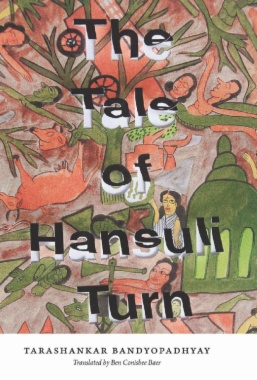
A terrifying sound disturbs the peace of Hansuli Turn, a forest village in Bengal, and the community splits as to its meaning. Does it herald the apocalyptic departure of the gods or is there a more rational explanation? The Kahars, inhabitants of Hansuli Turn, belong to an untouchable "criminal tribe" soon to be epically transformed by the effects of World War II and India's independence movement. Their headman, Bonwari, upholds the ethics of an older time, but his fragile philosophy proves no match for the overpowering machines of war. As Bonwari and the village elders come to believe the gods have abandoned them, younger villagers led by the rebel Karali look for other meanings and a different way of life.
As the two factions fight, codes of authority, religion, sex, and society begin to break down, and amid deadly conflict and natural disaster, Karali seizes his chance to change his people's future. Sympathetic to the desires of both older and younger generations, Tarashankar Bandyopadhyay depicts a difficult transition in which a marginal caste fragments and mutates under the pressure of local and global forces. The novel's handling of the language of this rural society sets it apart from other works of its time, while the village's struggles anticipate the dilemmas of rural development, ecological and economic exploitation, and dalit militancy that would occupy the center of India's post-Independence politics.
Negotiating the colonial depredations of the 1939–45 war and the oppressions of an agrarian caste system, the Kahars both fear and desire the consequences of a revolutionized society and the loss of their culture within it. Lyrically rendered by one of India's great novelists, this story of one people's plight dramatizes the anxieties of a nation and the resistance of some to further marginalization.
- Front Cover
- Front matter
- Half-title
- Series information
- Title page
- Copyright information
- Table of contents
- Acknowledgments
- Body
- General Introduction
- Selected Secondary Sources
- PART ONE: RELIGIOUS IDEOLOGIES
- Introduction
- Selected Secondary Sources
- IDEAS AND BELIEFS
- The Heretic: Contingent and Commodified
- Selected Secondary Sources
- Censorship and Criminalization
of Ideas in Western Europe
- Dangerous Ideas
- Criminalizing Ideas—Official Measures
- Criminal Taint—Rhetoric and Perception Among Scholastics
- Behaviour Regarding Criminal Ideas—Censure and Criticism
- Conclusion
- Selected Secondary Sources
- Medieval Suicide
- Church Doctrine
- The Stoic-Christian Dialectic
- Canon Law
- Roman Law
- Enforcers, Breakers, and Benders of the Law
- Select Secondary Sources
- SEXUALITY
- Attitudes to Same-Sex Sexual Relations in the Latin World
- Marriage and Sexuality in China, 960–1368 CE
- Marriage and Universal Order: The Song Penal Code
- Local Practice and Universal Law: Song Verdicts
- Local Practice and Ethnic Hierarchy: Yuan Precedents
- Conclusion
- Select Secondary Sources
- MONEY
- Usury as Deviance in Medieval Europe
- Usury and Medieval Economic Thought
- Deviance Defined: Labelling Usury (ca. 1140–1200)
- Deviance Controlled: Usury Regulated (ca. 1200–1270)
- Deviance Eradicated: Expelling Usurers (ca.1270–1310)
- Conclusion
- Select Secondary Sources
- PART TWO: POLITICAL IDEOLOGIES
- Introduction
- TREASON
- El and Bulqa: Between Order and
Chaos in the Formative Years of
the Mongol Empire (1206–1259)
- The Legacy of Chinggis Qan
- Social and Political Hierarchies
- Customary Obligations
- Conclusion
- Select Secondary Sources
- Treason in France and England in
the Later Middle Ages
- Top-Down Discourses on Treason and Lese Majesty
- Bottom-Up Experiences with Treason
- Conclusion
- Select Secondary Sources
- Revolts in the Late Medieval Middle East, 1200–1500
- Framing Rebellion in Islamic Law (Second/Eighth–Seventh/Thirteenth Centuries)
- Revolting in the Late Medieval Middle East: Politico-Religious Attitudes and Discourses
- Political Rebellions Against the Authority of the Sultan:
Apostasy and Takfīr
- Popular Rebellions Which Did Not Challenge the Authority and Legitimacy of the Sultan: Negotiation, Violence, and Punishment
- Conclusions
- Selected Secondary Sources
- POLITICAL VISIONS OF COMMUNITY
- Power, Scapegoating, and the Marginalization of Jews in Western Europe in the High Middle Ages
(Eleventh–Fourteenth Centuries)
- The Power of Christian Society
- The Power of the Church
- The Power of Civil Authorities
- Christian Reaction to the Agency of Jewish Communities
- Conclusion: Jews as “Other”
- Selected Secondary Sources
- Articulating and Contesting Power
in the Twelfth-Century Maghrib
- The Religio-Political Context
- The Almohad Religio-Political Narrative of Righteousness
- The Uprising of the Counter-mahdī al-Hādī
- Divine Retribution in Ibn al-Zayyāt al-Tādilī’s Kitāb
al-Tashawwuf ilā Rijāl al-Taṣawwuf
- Selected Secondary Sources
- Social and Environmental Policing
- Introduction
- Constructing Deviance through Policing
- Constructing Deviants through Policing
- Policing and Good Governance
- Conclusion: Urban Policing in and Beyond Western Europe
- Selected Secondary Sources
- PART THREE: LEGALISM
- Introduction
- Selected Secondary Sources
- THEFT
- Shifting Attitudes to Theft in Medieval Western Europe
- Terminology
- Dealing With Theft
- The Progressive Criminalization of Theft
- The Criminalization of Habitual Criminals
- Vagabondage and Brigandage
- Conclusion
- Selected Secondary Sources
- “This may bring about many evils”:
The Jewish Minority Community in Medieval Europe Facing Its Own Thieves
- Introduction
- Theft and Thieves in the Twelfth Century “Book of Awe”
and in “The Book of the Pious”
- The “Walking Dead”—Property, Robbery, and the Limits
of Repentance
- The Synagogue Break-in in Daroca (Aragon)
- Selected Secondary Sources
- VIOLENCE
- The Criminalization of Violence
in the Medieval West
- Selected Secondary Sources
- Rape and Law in Medieval Western Europe
- Defining the Deviant
- Legal Limits
- Paradigmatic Parties
- Condemnation and Concrete Action
- Conclusion
- Selected Secondary Sources
- An Analysis of “Rape” in Islamic Legal Discourse (1000–1500 CE)
- Introduction
- The Different Kinds of “Rape”
- Ikrāh (Duress/Coercion)
- Ghaṣb (Seizure/Misappropriation)
- Ṣiyāl (Assaults)
- Redress
- Conclusion
- Selected Secondary Sources
- WITHIN THE HOME
- Between the Muslim State and Individual Agency: The Regulation of Sexuality in the Jewish Communities of Medieval Egypt
- Case Studies
- Conclusion
- Selected Secondary Sources
- Attitudes to Domestic Violence in Christian Europe
- From Chastisement to Domestic Violence
- Diversity in Space and Time
- Assisting Victims of Abuse
- Distinctly Medieval
- Conclusion
- Selected Secondary Sources
- Back matter
- Epilogue
- index
- Thematic Indexes of Contents

 Texto
 Audio
 Adobe DRM


 Ingrese a su cuenta