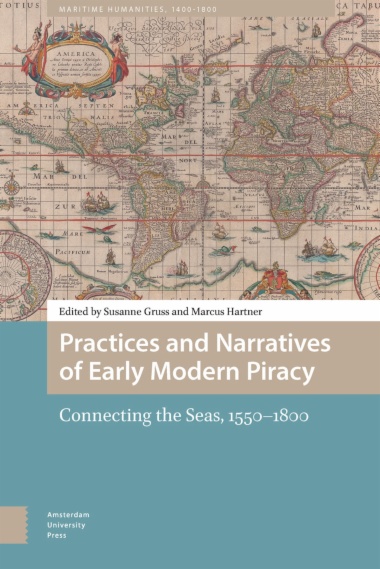
Rather than looking at different manifestations of early modern piracy as geographically and temporally isolated cultural phenomena, Practices and Narratives of Early Modern Piracy: Connecting the Seas (1550–1800) pursues a comprehensive approach to this field of study. This volume investigates the spatial, temporal, and economic connections between pirates and other seafarers who navigated the North Sea, the Mediterranean Sea, the Atlantic, and the Indian Oceans in the early modern period, and the cultural products they inspired. With a specific focus on historical practices and cultural narratives it addresses issues such as the appearance of pirates and piratical protagonists in diverse geographical locations, changing negotiations of pirate identity, the fluid boundary between illegal piracy and state-sanctioned privateering, and the (trans)national economic entanglements of different forms of maritime predation. By bringing together the discussion of literary, cultural, and historical aspects of piracy and seafaring, the volume explores the cultural as well as the ideological impact and function of the pirate figure in early modern historiography, literature, and popular culture.
- Cover
- Half Title
- Series Page
- Title Page
- Copyright Page
- Table of Contents
- List of Illustrations
- Acknowledgements
- Introduction: Practices and Narratives of Early Modern Piracy
- Part I: Political and Economic Entanglements
- Chapter 1: Pirate Marts and Knockdown Prices: Piracy, Class, and Economics in Early Modern England
- Chapter 2: Piracy and Sovereignty in the Indian Ocean: The British East India Company’s Campaign against Atlantic and Angrian Maritime Predation, 1717–24
- Chapter 3: Connecting Seas and Epochs: George Walker and Britain’s ‘Privateers of Force,’ 1744–48
- Chapter 4: Surviving Scarcity: Reconceptualizing Tunisian Corsairing during the Late Eighteenth and Early Nineteenth Centuries
- Part II: Pirate Mobility
- Chapter 5: Interconnected Identities: Seventeenth-Century ‘Barbary’ Pirates, Christian Captives, and Geo-Cultural Mobility
- Chapter 6: “Confinde to No Limits”: John Ward, a Renegade Life in Print
- Chapter 7: “Wrestling with the Restless Sea”: Piracy, European Expansion, and the Further Beyond
- Chapter 8: “Anchors Found on High Mountains”: Terraqueous Traffic and Pirate Mobility in Walter Ralegh
- Part III: Literary Accounts
- Chapter 9: Setting the Stage: Transnational Piracy and the Ambiguity of Pirate Identity in the Stukeley Plays
- Chapter 10: Commerce, Conflict, and Intercultural Contact: Figurations of Polyvalence in Thomas Heywood’s The Fair Maid of the West, Part I
- Chapter 11: From Captive to Privateer: William Rufus Chetwood’s The Voyages and Adventures of Captain Robert Boyle (1726)
- Index

 Text
Text
 Audio
Audio
 Adobe DRM


 Login to your account