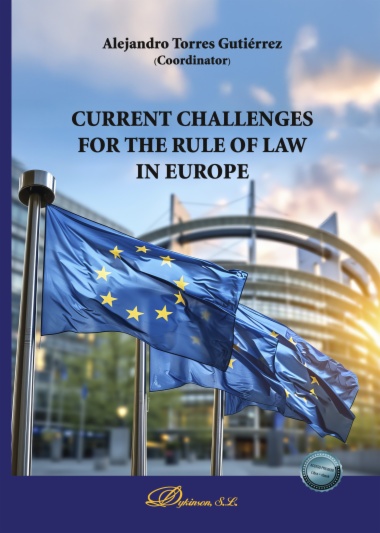
This book contains the proceedings of the International Conference titled “Current Challenges for the Rule in Europe”, held at the Public University of Navarre (UPNA) on May 26th–28th, 2025, within the framework of the Erasmus+ Project “Europia”, supported by the European Union. Erasmus+ Programme; Key action 2: Cooperation partnerships; Sector: Higher education. PIC 999888029. Grant Agreement No.: 2022–1–PL01–KA220–HED–000086334, coordinated by Prof. Dr. Spasimir Domaradzki, Lecturer in International Relations at the Faculty of Political Science and International Studies at the University of Warsaw (Poland).The results of this monograph serve to reflect on the main challenges facing the rule of law in Europe. These affect, for example, the complex mechanisms for the configuration of some state institutions, such as the governing bodies of the judiciary, and their correct functioning, and where problems can be replicated in a surprisingly similar way across the old continent.Certain aspects have to do with the need to have solid electoral procedures, or to harmonise European legislation, in particularly sensitive areas in the field of taxation. Additional questions are related to the correct use of regulatory instruments, especially by executive power, faced with the temptation to resort to legislating by means of Decree Laws, and even the risk of not legislating on matters in which it is necessary to do so, leaving minorities unprotected.Other topics analysed include those arising from the emergence of populism and the problems derived from it, or those related to digitalisation and artificial intelligence. Many opportunities and challenges appear disturbingly linked in this area.
- Cover
- Title page
- Copyright page
- Índice
- Introduction
- Part I. Conceptual introduction to the idea of “rule of law”
- What do we mean when we talk about “rule of law”?, Fernando Rey Martínez
- 1. Introduction: Rule of law, a polysemic concept
- 2. What do i understand by rule of law?
- 3. A good example of an attempt to break the rule of law: The amnesty law in spain (2024)
- Human rights from an anthropological perspective, Goran Pavel Santek
- 1. Introduction
- 2. The anthropological paradox of human rights
- 3. Anthropology and the aaa’s three statements on human rights
- 4. What could anthropology do with human rights?
- 5. Conclusion: Anthropology and human rights
- 6. Bibliography
- Rule of law, state of exception and arbitrariness in ancient law, Bernard Callebat
- 1. Introduction
- 2. Legality and aristocratic constitutionalism in greek magistracies
- 3. Equality and the plebeian function in roman-republican magistracies
- 4. Neutrality and ius privatum in the culture of jurisprudence
- 5. Bibliography
- Part II. The rule of law and the european union
- European multi-level democracy as seen from the principle of constitutional loyalty, Rosario Tur Ausina
- 1. Multi-level european constitutionalism. The “blurring” of power
- 2. Recourse to the principle of constitutional loyalty in the european order. Origins and configuration
- 3. Bidirectionality and polarisation. Imperfect loyalty
- 4. Loyalty and european constitutional sentiment
- 5. Epilogue. Loyalty and cross-level constitutionalism
- The rule of law and european integration. The (not) obvious nexus, Spasimir Domaradzki
- 1. Introduction
- 2. Political values and integration dilemmas
- 3. Association, values and the quest for membership
- 4. Conclusions
- 5. Bibliography
- The cjeu’s defence of eu values to preserve the european constitutional order, Pablo Cruz Mantilla de los Ríos
- 1. Introduction
- 2. The legal nature and binding character of eu values
- 3. The judicial revival of eu values
- 4. Present and future debates on eu values
- 5. Conclusions
- 6. Bibliography
- No rule of law in undemocratic societies: The eu legal framework to tackle threats to democracy, Silvia Giudici
- 1. Introduction
- 2. Democracy, rule of law and foreign interference
- 3. Democracy in the eu legal framework and challenges for its protection vis-à-vis foreign interference
- 4. The eu internal market competences: Limits and opportunities
- 5. The content of specific rules to tackle foreign interference through disinformation
- 6. Concluding remarks
- The rule of law in eu multiconstitutional dialogue: Towards its constitutional anchoring in eu citizenship, Mikel Díez Sarasola
- 1. Introduction
- 2. Rule of law. An immanent conception within the eu
- 3. Rule of law as an infrastructure for eu integration and control. Pitfalls and limitations
- 4. Strengthening EU Citizenship Through the Rule of Law: Exploring New Pathways
- 5. Final Remarks
- Europe facing the challenge of taxing multinationals: State aid – the apple case, Hugo López López
- 1. Introduction
- 2. Basic concepts of international taxation to understand the apple case: Tax residence; source-based taxation; attribution of profits to permanent establishments
- 3. Apple case
- 4. Legal assessment
- 5. Final considerations
- 6. Bibliography
- Europe facing the challenge of taxing multinationals: Global minimum tax, Marina Castro Bosque
- 1. Introduction
- 2. The problem drivers: Profit shifting and tax competition
- 3. The eu directive on pillar two: A global minimum tax for mnes
- 4. Critical remarks: The end to profit shifting and tax competition?
- 5. Conclusions
- 6. Bibliography
- Part III. Current challenges for the rule of law in western europe
- The conception of the rule of law in french law, Éric Ghérardi
- 1. Introduction
- 2. A french concept born of republican history and the centrality of the law
- 3. The gradual emergence of the rule of law in positive law
- 4. An evolving model influenced by europe and contemporary crises
- 5. Conclusion
- Administrative inertia as a violation of the principle of the rule of law in portugal, António Malheiro de Magalhães
- 1. Democratic and social state under the law and dignity of the human person
- 2. Regulatory administration and implementation of the principle of the social rule of law
- 3. Inertia of the regulatory administration and violation of the democratic and social state of law – “remedies to combat”
- 4. A functionally active regulatory administration and postponing inertia to safeguard the democratic and social state of law
- 5. Conclusion
- Part IV. Current challenges for the rule of law in eastern europe
- Limits of discretionary power and difficulties in applying the law in romania, Catălina Georgeta Dinu / Oana Şaramet
- 1. Short considerations about the constitutional regime in romania
- 2. Comments on constitutional and legal regulations and jurisprudential approaches relevant to discretionary power. Discretionary power or right of appreciation?
- 3. Comments on discretionary power in the adoption of emergency ordinances by the government of romania
- 4. Comments on discretionary power in the adoption of ministerial orders
- 5. Short conclusions
- Historical roots of the contemporary misunderstanding of the “rule of law” concept on the balkans – the case of bulgaria and others, Hristo Berov
- 1. Introduction
- 2. Theoretical framework: Classical and contemporary approaches of the rule of law
- 3. Historical development and difficulties in the bulgarian situation
- 4. Contemporary misunderstandings of the rule of law in bulgarian society
- 5. Conclusion
- 6. References
- Rule of law in serbia and its eu integration path, Ivana Radic Milosavljevic / Janja Simentic Popovic
- 1. Introduction
- 2. Theoretical framework – the europeanisation model
- 3. Analysis
- 4. Conclusions
- 5. References
- Some jurisprudential clarifications on the european union sanctions against russia, José Luis Iriarte Ángel
- 1. Introduction
- 2. The Ongoing Relevance of the Grounds for Sanctioning an Individual
- 3. Clarification of the Concept of “Association” with Sanctioned Persons
- 4. Clarification of the Concept of Material or Financial Support to Russian Politicians Responsible for the Annexation of Crimea or the Destabilization of Ukraine
- 5. Definition of the concept of leading businesspersons operating in russia
- 6. Clarification of the Concept of Businesspersons, Legal Persons, Entities, or Bodies Involved in Economic Sectors Providing a Substantial Source of Revenue to the Government of the Russian Federation
- 7. Clarification of the Concept of Advantages or Benefits Referred to in the Second Part of Article 3.1(g) of Regulation (EU) No 269/2014
- 8. Conclusions
- European union toward the support of rule of law initiatives in ukraine, Vadym Zheltovskyy
- 1. Introduction
- 2. Eu-ukraine relations in times of war: Toward the transformational shift of the status quo
- 3. The verkhovna rada and cabinet of ministers as facilitators of democratisation in ukraine
- 4. The russian invasion as a catalyst of eu-ukraine cooperation on rule of law reforms
- 5. Conclusive remarks
- Rule of law and the temptation of illiberalism: The case of eastern europe, Gabriela Răţulea / Arabela Briciu / Codrina Csesznek
- 1. Rule of law. definition and characteristics
- 2. Illiberalism, concept and paradigm
- 3. Tensions between the rule of law and illiberalism
- 4. Illiberal trends in eastern europe
- 5. Illiberal trends in romania
- 6. Conclusions
- Part V. The judiciary and the rule of law
- Constitutional courts and the rule of law: Navigating democratic integrity, Andreea Vertes-Olteanu
- 1. Introduction
- 2. Background
- 3. Protecting the rule of law – 2024 saga – first attempt
- 4. Protecting the rule of law – 2024 saga – second attempt
- 5. Aftermath
- 6. The venice commission’s take on election annulments
- 7. Conclusion
- Preventing lawfare: Is the independence of the judicial branch under suspicion?, Miryam Rodríguez-Izquierdo Serrano
- 1. Lawfare and judicial activism: An argument against the independence of the judicial branch?
- 2. The autonomy of the judicial branch in europe and its adversaries
- 3. The complexities of judicial lawfare: Judicial activism vs. judicial misconduct
- 4. Preventing lawfare in the european union
- 5. Conclusions
- Majority rule and its challenge to the rule of law: Defending constitutional pluralism in europe, Matteo Frau
- 1. The evolution of the rule of law: The function of the legislature in a free society under the rule of law
- 2. Majority rule and the transformation of the social contract
- 3. The persistence of the ‘majority-based rule of law’ in contemporary democracies despite its negative impact on constitutional pluralism and the fundamental interests of minorities
- 4. Rethinking the rule of law from a consensus democracy perspective
- 5. Conclusion: The need to restrain the “majority-based rule of law”, especially in the european context
- The role of the judge in the context of climate litigation: Boosting the fight against climate change and/or risk to the rule of law, Sergio Salinas Alcega
- 1. Introduction
- 2. The risk of climate litigation for the rule of law. The meaning of the principle of division of powers and the role of the judge
- 3. The principle of division of powers as an obstacle to the judge’s action in the fight against climate change. The approach in judicial practice
- 4. What contribution can climate litigation make to strengthening the response to climate change?
- 5. Conclusions
- Constitutional court: Regulation, politics and the human factor. The tightrope walker and the balance pole, Asunción de la Iglesia Chamarro
- 1. Preliminary considerations
- 2. The guardian faced with the potential risk for the first division of powers: Constituent and constituted power
- 3. Constitutional court: Different times, different conditions, adequated profiles
- 4. A brief reference to the spanish case
- 5. A proposal to recover prestige: Judicial independence, suitability and the human factor
- 6. To finish: Returning to the figure of the tightrope walker: Recover prestige or fall
- Standards for judicial councils in the case law of the cjeu and the ecthr. From soft law to hard law?, Núria González Campañá
- 1. Introduction
- 2. Cjeu case law concerning councils for the judiciary
- 3. Ecthr case law concerning councils for the judiciary
- 4. Conclusions
- The rule of law and judicial independence in the face of the primacy of eu law: Conflicts between the cjeu and the constitutional courts, Ander Loyola Sergio
- 1. Introduction: New formulations of an old jurisdictional conflict
- 2. Brief historical experience on the clashes between the cjeu and constitutional courts on the principle of primacy
- 3. Judicial independence as a new cause of conflict
- 4. Luxembourg in the mirror of european integration: From ultra vires control to a clash of legitimacy
- 5. Conclusions: A conflict beyond the judge’s robe
- 6. Bibliography
- 7. Case–law
- Rule of law, judicial independence and government of the judiciary in spain, Sergio Díaz Sánchez
- 1. Introduction
- 2. The unique spanish case: Parliamentary election of all council of the judiciary members
- 3. European standards for the election of members of judicial councils
- 4. Primacy of the democratic principle?
- 5. Proposed solutions
- Part VI. Legislative function and rule of law
- The abusive use of the royal decree law by the executive in spain, Alejandro Torres Gutiérrez
- 1. Introduction
- 2. Constitutional enabling conditions: Extraordinary urgency and necessity
- 3. The exception becomes the rule
- 4. Clear cases of misuse of the decree-law
- 5. The need for parliamentary control
- 6. The autonomous communities join the party
- 7. Conclusion
- 8. Bibliography
- Nationals, indigenous peoples, migrants, stateless persons, refugees and diasporas: A global view from international law, José Manuel Olivar de Julián
- 1. Introduction
- 2. Nationals, nationality as a legal status
- 3. Indigenous peoples
- 4. Migrants
- 5. Stateless persons
- 6. Refugees
- 7. Diasporas
- 8. Conclusions
- 9. Bibliography
- Negative effects of regulatory fragmentation on social protection of ministers of religion in spain, Ángel Ares y García
- 1. Introduction
- 2. Substantiation of the initial thesis: Appreciation and reasoning exercises at the relational level through different approaches to the problem
- 3. Proposal for future law and regulation
- 4. Bibliography
- Current challenges for electoral management in france and in spain, Camilla Yselsa Féliz de la Cruz
- 1. First challenge: What is electoral management?
- 2. Second challenge: French and the spanish electoral management design
- Part VII. Populism and the rule of law
- Democratic principle, populism and rule of law, José Tudela Aranda
- 1. Introduction
- 2. Spain and the rule of law
- 3. Rule of law and new populism
- 4. New populism, polarisation and fragmentation
- 5. The rule of law at risk
- 6. Final reflection
- The rise of the far right in europe. A study of several milestones from a legal historical perspective, Amaia Álvarez Berastegi
- 1. Introduction
- 2. The historical and legal context
- 3. Critical elements to framing the curent far right
- 4. Conclusions
- 5. Bibliography
- Democracy, public opinion and algorithmic literacy: The case of the spanish xenometer (s-xenometer), artificial intelligence against xenophobia, Sergio García Magariño / Ignacio Sánchez de la Yncera, Mikel Ferrero Jaurrieta / Beth Lyon / Lucía Pérez Peña
- 1. General framework: Introductory contextualization
- 2. The spanish xenophobia meter
- 3. Results, limitations and future steps
- 4. Conclusion
- Part VIII. Rule of law in the digital age
- How eu digital policy is shaping the digital rule of law in the european union, Dominika Harasimiuk
- 1. Introduction
- 2. Eu digital policy – an overview
- 3. The digital rule of law
- 4. Rights-driven digital policy in the eu – eu declaration on digital rights and principles for the digital decade
- 5. Conclusion
- 6. Bibliography
- Protecting individuals in the digital age from online search engine activity, Beatriz Aguinaga Glaria
- 1. Introduction
- 2. Functionality and impact of online search engines
- 3. European regulatory approach to the protection of individuals against online search engines
- 4. Conclusion
- 5. Bibliography
- Shifting sands: The us–eu data privacy framework in a changing political landscape, Xabier Orbegozo Miguel
- 1. Context
- 2. Personal data as the great XXI century asset
- 3. The ecj judgement of 16 july 2020 – “schrems II”
- 4. Next steps in the case
- 5. The data privacy framework
- 6. Status quo of the dpf – the european commission and edpb reports
- 7. The latombe case and “trump effect” – legal uncertain- ty returns
- 8. Conclusions
- Risks of the digital euro project, Javier Martín-Lanas
- 1. Introduction
- 2. On money
- 3. Risks of the future digital euro

 Texto
 Audio
 Adobe DRM


 Ingrese a su cuenta