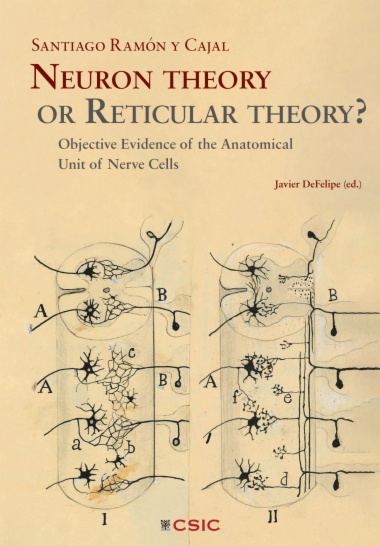
Current knowledge of the nervous system, particularly the brain, is the result of technological advances and the collective effort of many scientists. However, it was Santiago Ramón y Cajal (1852-1934) who played a crucial role in the emergence of modern neuroscience. His extraordinary ability to observe and interpret microscopic images allowed him to discover details overlooked by others, thus revolutionizing the understanding of the nervous system. Cajal investigated the microanatomy of almost the entire nervous system and formulated theories about its function, development, and plasticity, which profoundly influenced the science of his time and laid the foundations for current neuroscience. Among his greatest achievements was his defense of the neuron theory, which establishes that neurons are individual units, as opposed to the reticular theory that proposed a continuous network. His seminal work on this debate, "Neuronismo o Reticularismo", was published in 1933 in the journal Archivos de Neurobiología. The text in this reissue remains faithful to the original, preserving its explanatory notes and bibliographic citations intact. Linguistically, the text remains perfectly understandable, although some outdated scientific terms have been reviewed and replaced with their current equivalents. This edition also includes an introductory chapter expanding on the historical aspects of the debate, a section on the ultrastructural confirmation of the neuron theory through electron microscopy, and an analysis of recent findings that challenge some aspects of this theory. With 73 figures, including 42 original drawings by Cajal, this reissue serves as a valuable reference for the scientific community and a tribute to the legacy of one of the greatest pioneers of neuroscience.
- Cover
- Title page
- Copyright page
- Index
- The cajal librarypioneers of neuroscience collection
- Introductory study
- Introduction
- History of the neuron
- Relationship between nerve cells and nerve fibers
- The reazione nera and the discovery of the detailed morphology of the nerve cell
- Theories on the organization of the nervous system: reticular theory and neuron theory
- The resurgence of the Reticular Theory: Golgi versus Cajal
- Ultrastructural confirmation of neuronal individuality: the discovery of the synaptic cleft
- The neuron theory in the modern era:new horizons in neuroscience
- Electrical synapses
- Volume transmission
- Other modalities of interaction among the components of the nervous system
- New technologies for three-dimensional study of synaptic organization
- Concluding remarks
- Bibliography
- NEURON THEORY OR RELICULAR THEORY?
- Preface I
- Translators’ Note
- Preface II
- 119 Neuron theory or Reticular theory?Ramón y Cajal, an appreciation
- Neuron Theory or Reticular Theory? Objective Evidence of the Anatomical Unity of Nerve Cells
- PART ONE
- 01 Historical notes about the neurontheory
- 02 Histological proofs
- Varieties of Synapses.The Cellular Membrane
- 03 1. Axo-somatic connections bymeans of nerve baskets rich infibers («nests» or «baskets» of thecerebellum, etc.)
- 2. Axo-somatic connections by means ofbaskets or nests poor in axonal branches
- 04 3. Nests or chalices of Held in thenucleus of the trapezold body
- Critical observations of Held and doubts of Bielschowsky.–
- 4.-Axo-somatic connections in the ventralcochlear nucleus
- 05 5. Peripheral terminations of the cochlear nerve in the organ of Corti. Terminations of the vestibular nerve
- 06 6. Axo-somatlc connections bymeans of thick terminal tubercleswith or without pericellularprojections. (Retina). Tubercles ofthe vestibular nerve in the lateralnucleus of the medulla in birds andfishes. Bulbs of Held. «Endfüssen»of the motor nerves
- 07 7. Climbing fibers or longitudinal axo-dendriticconnections. Axo-dendriticconnections by means of gears
- 08 9. Cruciform axo-dendriticconnections of great length.Molecular layer of the cerebellumand the interpeduncular nucleus
- 09 10. Terminations upon circunscribed cellular pleiades. Connections in the thalamus. Complex connections in the cerebral cortex
- 10 11. Apparent objections to the neuron theory based on recent studies of the sensory and motor end-organs
- 11 12. The latest conception of Held on the structure of the gray substance
- PART TWO
- 12 I. Neurogenetic unity as a proof of the neuron theory. Free growth of the axons in tissue culture. Error of the supposed initial ensheathment in the course of the embryonic axons. Free growth of the newlyformedfibers in the scar of the sectioned nerve
- 13 II. Anatomicopathologlcal facts favorable to the neuron theory. Persistence of the baskets and other pericellular terminations, etc.
- Conclusion
- Bibliography
- Index of authors
 Text
Text
 Audio
Audio
 Adobe DRM


 Login to your account