
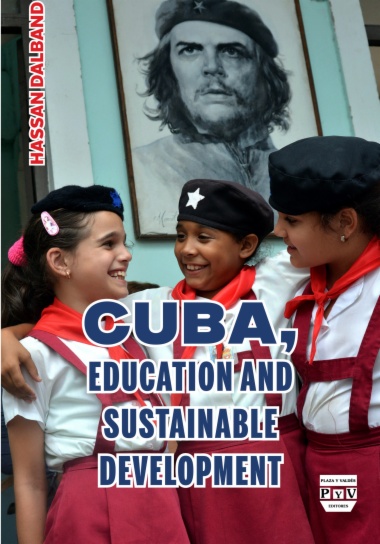
To the esteemed readers who engage with the book Cuba, Education and Sustainable Development by Dr. Hassan Dalband, I begin by sharing that in this work, I find, above all, A hymn of love to the people, the teacher, and education. The book Cuba, Education and Sustainable Development is one of the outcomes of the thorough investigative work carried out by Dr. Dalband, aimed at conducting a critical analysis of the characteristics, pathways, and methods employed by the capitalist educational system to exert domination over the working class and the general population. This is contrasted with popular and socialist education as an alternative to hegemonic education, drawing on the Cuban experience. The text boasts a variety and richness in the sources used by the author, who draws on extensive and up-to-date bibliography from Cuban authors, those of other nationalities, and international organizations and bodies. It includes periodical publications, official reports, and interviews conducted with educators, academics, and specialists in education and pedagogy who have participated in the transformations brought about by the Socialist Revolution in education. The relationship between education, socialism, and participatory democracy holds a special place in this part of the work. Here, the author delves into the need to understand the term and significance of Popular Education within the socialist system. In the reflections of some of the interviewed experts, certain prejudices are evident regarding the necessity of adopting Popular Education when the people are in power. The author emphasizes the essential connection between Popular Education, participatory democracy, and socialism as the main foundations of a liberating, participatory, revolutionary, collective, and humanist education. The author concludes this rigorous work by asserting that, based on the Cuban example, “it is possible to build an economic, social, political, cultural, and gender system with socialist characteristics as happens with the Cuban and Caribbean interpretation, promoting social justice and individual and collective well-being. A form of government with participatory and inclusive democracy, featuring accountability and the mandate revocation.” With socialist-oriented Popular Education, it is possible to create a better world for the entire global population, and without it, this is impossible. Dr. Lesbia Cánovas Fabelo Honorary Academic, Cuban Academy of Sciences Havana, October 2022
 Text
Text
 Audio
Audio
 Adobe DRM


 Login to your account