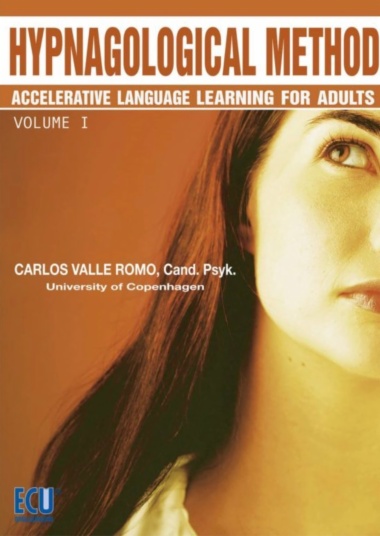
First volume of a two-part work in which Carlos Valle Romo, graduate in Psychology from the University of Copenhagen, presents the 'Hypnagological Method', an original approach to accelerative foreign-language learning for adults. Grounded in critical rationalism, Chomskyan, Piagetian and Vygotskian principles, and autogenic and suggestopedic theories, the book sets out the theoretical foundations of the method, discussing the adult learner as a rational being, the process of demythologisation of language learning, and the distinction between grammar rules and logical-rational rules. Volume I lays the conceptual groundwork that is later applied and developed further, with practical implications, in Volume II. The work is aimed at linguists, language teachers and researchers interested in alternative pedagogical models.
- Cover Page
- Title page
- Copyright Page
- Index
- Chapter 1. Introduction
- Chapter 2. Considerations and Observations
- Chapter 3. Basic Grounds of Intensive Language Courses
- 1. Nature and principles of learning
- 2. Interests of the Individual
- 3. Classical conditioning and its implications
- 4. Contiguous Conditioning
- 5. Purpose Behaviourism
- 6. Secondary reinforcements
- 7. Operant conditioning and its influence
- 8. Mediation Processes between Stimulus and Response
- 9. Two-Process Learning Theory
- 10. Learning through Observation
- 11. Cognitive Theories
- 12. Generative-Transformational Grammar
- 13. Development Theory
- 14. Socio-Historical Psychology
- 15. The Psychology of Set
- 16. Gestalt Therapy
- 17. Transactional Analysis
- 18. Neuro-linguistic Programming
- 19. Physiological Psychology
- Chapter 4. Historical Perspective
- 1. Grammar and Translation Model
- 2. Direct Model
- 3. Reading Model
- 4. Audio-Linguistic Model
- 5. Cognitive Model
- 6. Humanistic/Affective Model
- 7. Functional/LSP Model
- 8. Summary about the different Models-Approaches
- 9. Total Physical Response
- 10. The Silent Way
- 11. Community Language Learning
- 12. Suggestology and its Influence
- Chapter 5. Theoretical Foundations of Accelerated Language Learning
- 1. The Age Factor
- 2. The Intelligence Factor
- 3. The Memory Factor
- 4. The Attention Factor
- Chapter 6. Theoretical Foundations of Accelerated Language Teaching
- 1. Brain lateralisation
- 2. Autogenics – concentrative relaxation
- 3. Systematic Desensitisation
- 4. Sound analysis
- 5. Hypnosis and self-hypnosis
- 6. Rhythm in Suggestology
- 7. Training: the maieutic method
- Chapter 7. Towards an Open Teaching/Learning System
- 1. Basic principles
- 2. Memory Activation
- 3. Process of Demythologisation
- a. Age
- b. It is necessary to be intelligent
- c. Having linguistic talent
- d. «I know people who have learned talking to foreigners in bars»
- e. Musical Ear
- f. «I am gifted for Mathematics, not for languages»
- g. «I want to learn Castilian» / «I want to learn Oxford's English»
- h. «I do not know how to relax»
- i. How am I to retain all that amount of information in so little time?
- j. I do not think I am able to concentrate for so many hours a day

 Text
Text
 Audio
Audio
 Adobe DRM


 Login to your account