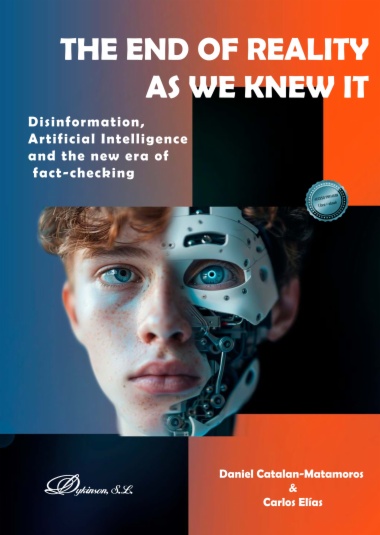
The search for reality in the 21st century has become a task of unprecedented complexity, marking the dawn of the “Information Disorder” era where trust in global information ecosystems is being deliberately eroded. By 2025, estimates suggest that up to 62% of online content may be false or artificially generated, exposing 86% of the population to deceptive narratives. This book, The End of Reality: Disinformation and the Fact-Checking Era, serves as a comprehensive cartography of this landscape, integrating perspectives from 75 internationally renowned scholars across 20 countries. Through six sections, the authors discuss the philosophical foundations of our post-truth condition, exploring concepts like “I-pistemology”, where subjective life experience replaces institutional expertise. The volume unmasks the “synthetic illusions” of Large Language Models and the rise of “synthetic friends”: AI companions that create impenetrable epistemic cocoons. From the information warfare in geopolitical conflicts to the visual distortions during natural disasters like the 2024 DANA foods in Spain, this work provides a multidisciplinary exploration of how truth is contested. It goes beyond simple debunking to propose new technological and collaborative frameworks for verification, such as the MonitorIA project for Telegram and the DISINFOX platform. By addressing the “human factor” through cognitive resilience models like the “Wave and Wall”, this book offers a roadmap for navigating an ecosystem where the distinction between truth and synthetic illusion has become a defining battlefeld of our time. Finally, these chapters remind us that reality is a collective achievement requiring constant defense and ethical stewardship of our informational behaviour.
- Cover
- Title page
- Copyright page
- Contenido
- Preface
- Searching for reality: an introduction to the current disinformation landscape
- Section I: Living in the fog: philosophical and rhetorical foundations of reality
- Speculative attitude in the construction of truth: a discussion on the weakening of factual truth consciousness in a post-truth era
- Beyond fact-checking: a contestivist approach to disinformation
- To scroll or to trust? The new battleground of truth on social media
- From information disorder to epistemic trust: rethinking disinformation in climate communication
- Re-signifying resistance: platform drift and the sonic afterlives of Bella Ciao and Grândola, Vila Morena
- Section II: Synthetic illusions: the algorithmic mechanics of truth distortion
- Good vs evil: artificial intelligence in the battle against disinformation
- The role of social media platforms in amplifying fake news and rumours: societal risks in the era of unmoderated content
- Users' perception of information manipulation by potentially automated accounts on X: the case of the Covid-19 health crisis
- Selective agreement in LLM debates: anchoring effects and resistance to disinformation
- Synthetic friends: AI companions and the future of disinformation
- Crowdsourced truth and ideological imbalance: the case of community notes
- Section III: The fabric of realities: identity, geopolitics, and narratives
- The effect of information warfare on national security in a geopolitical context: the case of the United Kingdom
- The parallel battlefield: how disinformation and bots shaped narratives in the 12-day Israel-Iran war
- War reporters in conflict zones: professional practices, disinformation, security risks and strategic responses
- Disinformation and migrant narratives: analyzing Spanish-language posts on X about migrants and refugees in Chile (2024)
- Countering disinformation efforts during the general elections in Kenya: identifying challenges with fact-checking initiatives
- How right-wing media sabotaged a judge's appointment: the Brosius-Gersdorf disinformation campaign
- Micro-influencers and disinformation: shaping environmental narratives online
- In Brazil, a president “sent by God”: fake news as a communication tool of the far-right
- Between documentation and distortion: visual disinformation and photojournalistic framing of the 2024 DANA floods in Spain
- Section IV: The fragile perception: cognitive vulnerability and public opinion
- Cognitive overload: the new normal
- Integrating information behaviour and technocognition: a methodological approach to AI-driven misinformation
- Who dares to share? Assessing perceptions of disinformation in Cyprus
- From content to publics: a case for focusing on disinformation audiences
- Trust in fact-checking: a literature review on public perceptions and credibility challenges
- Negativism and sensationalism in TV news: between information overload and emotional impact
- Memory literacy, remix culture, and the future of remembrance in the digital age
- The role of racial science in disinformation and misinformation
- Section V: The reality lab: digital tools and human networks in fact-checking
- The future of check-worthiness detection
- Designing AI tools to combat disinformation on Telegram within a human-in-the-loop approach: the monitorIA project
- The epistemic community of fact-checkers: a case study on the meaning-making of audience engagement in a platformized public sphere
- Enabling European fact-checker cooperation through the DISINFOX platform
- Disinformation and political polarization: fact-checking examples from the ATENA project
- AI as tool for detecting disinformation and developing critical thinking
- Digital activism and empowerment in the promotion of public health: the role of social media in vaccine mobilization in Brazil
- Disinformation of infographics in health communication: a comparative analysis of Brazilian and Spanish newspapers
- Section VI: The future of reality: ethics, resilience, and sustainable truth
- The gossiping machine: ethical tensions in AI-assisted verification systems as information ecosystem actors
- On their terms: designing intervention against misinformation with games designers and social media influencers
- Gamification for disinformation prevention
- Sustainability and visibility: rethinking fact-checking beyond platform funding
- Legal liability and the propagation of misinformation: will social media go the way of Big Tobacco?
- Reforms from yesterday that were lost in translation
- Strategic communication on social media in the fight against disinformation: an analysis of Slovak Ministry of Interior before the 2023 parliamentary elections

 Text
Text
 Audio
Audio
 Adobe DRM


 Login to your account