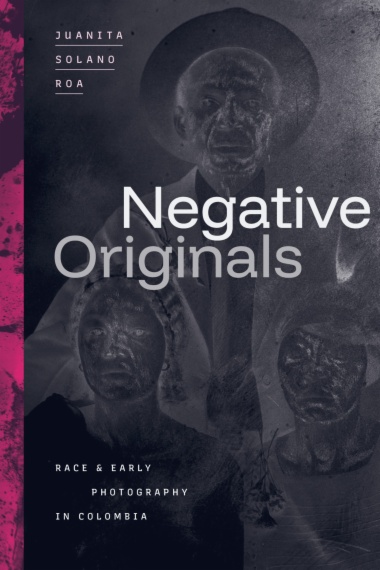
In Negative Originals, Juanita Solano Roa explores race and identity through photographic practices in late nineteenth-century Medellín, Colombia. Focusing on the photographic studios of Fotografía Rodríguez and Benjamín de la Calle, Solano Roa examines the visual construction and dissemination of racial ideologies and the linkage of race to progress. She studies both positive and negative prints to highlight the juxtaposition of traditional portraiture, which reinforced prevailing racial ideologies, and subversive depictions of often excluded individuals such as cross-dressers, peasants, the poor, and Afro-Colombians. In redefining photography’s role, Solano Roa shifts the critic’s eye from traditional positive prints to negatives, exposing the form’s material, symbolic, and spatial significance. In doing so, she simultaneously uncovers new perspectives on the medium and challenges hegemonic histories. Engaging one of Latin America’s most important photographic archives, Solano Roa addresses urgent gaps in the history of Colombian and Latin American photography, particularly at the intersection of race, gender, and the construction of whiteness.
- Cover
- Contents
- Acknowledgments
- Introduction
- Chapter One. Envisioning a New Race: Photographic Manipulation and the Discourse of la raza antioqueña
- Chapter Two. The Pictorial Negative: The Work of Horacio Marino and Melitón Rodríguez
- Chapter Three. The Negative in Suspense: Deviant Subjects and Bodies in the Work of Benjamín de la Calle
- Chapter Four. Orientalism in the Andes: Itinerant Images and Distant Negatives
- Chapter Five. Negative Spaces: The Backdrops in Benjamín de la Calle’s and Fotografía Rodríguez’s Photographs
- Notes
- Bibliography
- Index



 Login to your account
