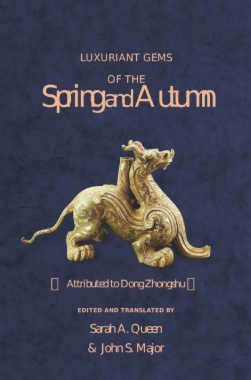
Luxuriant Gems of the Spring and Autumn Luxuriant Gems of the Spring and Autumn

Luxuriant Gems of the Spring and Autumn

  • Author: Dong, Zhongshu; Major, John; Queen, Sarah
  • Publisher: Columbia University Press
  • ISBN: 9780231169325
  • eISBN Pdf: 9780231539616
  • Place of publication:  New York , Spain
  • Year of digital publication: 2024
  • Month: February
  • Pages: 166
  • Language: English
The Cinema of Latin America is the first volume in the new 24 Frames series of studies of national and regional cinema. In taking an explicitly text-centered approach, the books in this series offer a unique way of considering the particular concerns, styles and modes of representation of numerous national cinemas around the world. This volume focuses on the vibrant practices that make up Latin American cinema, a historically important regional cinema and one that is increasingly returning to popular and academic appreciation. Through 24 individual concise and insightful essays that each consider one significant film or documentary, the editors of this volume have compiled a unique introduction to the cinematic output of countries as diverse as Brazil, Argentina, Cuba, Mexico, Bolivia, Chile and Venezuala. The work of directors such as Luis Buñuel, Thomas Guiterrez Alea, Walter Salles, and Alfonso Arau is discussed and the collection includes in-depth studies of seminal works as such Los Olvidados, The Hour of the Furnaces, Like Water For Chocolate, Foreign Land, and Amoros Perros.

  • Foreword
  • Acknowledgements
  • 0. Introduction
    • 0.1. History of Essaouira (Mogador)
    • 0.2. Method and Fieldwork
  • GRAMMAR
    • 1. Phonetics and Phonology
      • 1.1. Vowel phonemes
        • 1.1.1. Short vowels and allophones
          • 1.1.1.1. Allophones of /ə/
          • 1.1.1.2. /ŭ/ and allophones
        • 1.1.2. Long vowels and allophones
          • 1.1.2.1. /ā/ and allophones
          • 1.1.2.2. /ī/ and allophones
          • 1.1.2.3. /ū/ and allophones
        • 1.1.3. Vowels in loanwords from other languages
        • 1.1.4. Diphthongs
        • 1.1.5. Vocalic phenomena
          • 1.1.5.1. Metathesis or inversion
          • 1.1.5.2. Elision
          • 1.1.5.3. Lengthening or base alteration
      • 1.2. Consonantal phonemes
        • 1.2.1. Labials
        • 1.2.2. Dentals
        • 1.2.3. Sibilants
        • 1.2.4. Laterals
        • 1.2.5. Trill
        • 1.2.6. Postalveolar fricatives
        • 1.2.7. Velars
        • 1.2.8. Uvular
        • 1.2.9. Pharyngeals
        • 1.2.10. Glottal
        • 1.2.11. Semiconsonants
        • 1.2.12. Consonantal phenomena
          • 1.2.12.1. Labialization
          • 1.2.12.2. Alternation of /l/ and /n/
          • 1.2.12.3. Reduction and assimilation
      • 1.3. Syllabic structure
    • 2. Verbal Morphology
      • 2.1. Perfect
      • 2.2. Imperfect
      • 2.3. Imperative
      • 2.4. Triliteral verb
        • 2.4.1. Strong verb: simple form
        • 2.4.2. Geminate verb: simple form
        • 2.4.3. Hollow verb: simple form
        • 2.4.4. Defective verb: simple form
        • 2.4.5. Assimilated verb: simple form
        • 2.4.6. Irregular verbs with mixed conjugations
      • 2.5. Derived verbal forms or measures
        • 2.5.1. Form II
          • 2.5.1.1. Strong verb
          • 2.5.1.2. Geminate verb
          • 2.5.1.3. Hollow verb
          • 2.5.1.4. Defective verb
          • 2.5.1.5. Assimilated verb
        • 2.5.2. Form III
          • 2.5.2.1. Strong verb
          • 2.5.2.2. Geminate verb
          • 2.5.2.3. Hollow verb
          • 2.5.2.4. Defective verb
          • 2.5.2.5. Assimilated verb
        • 2.5.3. Form V
          • 2.5.3.1. Strong verb
          • 2.5.3.2. Geminate verb
          • 2.5.3.3. Hollow verb
          • 2.5.3.4. Defective verb
          • 2.5.3.5. Assimilated verb
        • 2.5.4. Form VI
          • 2.5.4.1. Strong verb
          • 2.5.4.2. Defective verb
        • 2.5.5. Form VII
        • 2.5.6. Form VIII
          • 2.5.6.1. Strong verbs
          • 2.5.6.2. Hollow verb
        • 2.5.7. Form IX
        • 2.5.8. Form X
      • 2.6. Quadriliteral verb
      • 2.7. Mediopassive forms
        • 2.7.1. Verb dzād
        • 2.7.2. Verb dǝzbād
      • 2.8. Verbal aspects
        • 2.8.1. Perfect
        • 2.8.2. Imperfect
          • 2.8.2.1. Preverbs ta- and ka-
          • 2.8.2.2. No preverb
        • 2.8.3. Auxiliary kān
        • 2.8.4. Future
          • 2.8.4.1. ġādi
          • 2.8.4.2. bġa~ba with imperfect verb
      • 2.9. Verbal negation
    • 3. Nominal Morphology
      • 3.1. Morphological patterns
        • 3.1.1. Biliteral nouns
        • 3.1.2. Triliteral nouns
          • 3.1.2.1. Triliteral nouns with internal modification
        • 3.1.3. Quadriliteral nouns
          • 3.1.3.1. Quadriliteral nouns with internal modification
        • 3.1.4. Paradigms with no classification
        • 3.1.5. Paradigms with suffix
        • 3.1.6. Paradigms with prefix
      • 3.2. Gender
        • 3.2.1. Masculine
        • 3.2.2. Feminine
      • 3.3. Number
        • 3.3.1. Collective name
        • 3.3.2. Dual
        • 3.3.3. External plural
        • 3.3.4. Broken plural
        • 3.3.5. Number agreement
      • 3.4. Adjective
        • 3.4.1. Comparative and superlative
        • 3.4.2. Diminutive
      • 3.5. Numbers
        • 3.5.1. Cardinal numbers
        • 3.5.2. Ordinal numbers
      • 3.6. Article
        • 3.6.1. Definite article
        • 3.6.2. Indefinite article
      • 3.7. Pronouns
        • 3.7.1. Independent pronouns
        • 3.7.2. Clitic or suffix pronouns
        • 3.7.3. Demonstrative pronouns
        • 3.7.4. Interrogative pronouns
        • 3.7.5. Relative particle
        • 3.7.6. Reflexive particle
        • 3.7.7. Indefinite pronouns
      • 3.8. Genitive
        • 3.8.1. Sinthetic
        • 3.8.2. Analytic
      • 3.9. Prepositions
      • 3.10. Adverbs
        • 3.10.1. Place
        • 3.10.2. Time
        • 3.10.3. Quantity and Intensity
        • 3.10.4. Manner
        • 3.10.5. Uncertainty
      • 3.11. Modals
      • 3.12. Conjunctions
        • 3.12.1. Coordinate
        • 3.12.2. Subordinate
      • 3.13. Nominal Negation
  • TEXTS
    • 4. Texts
      • 4.1 Text: The wedding tradition
      • 4.2. Text: The childhood in the countryside
      • 4.3. Text: The landscape of Essaouira
      • 4.4. Text: The former fishermen
      • 4.5. Text: The fishing techniques
      • 4.6. Text: A fisherman work song
      • 4.7. Text: The Jewish neighbors
      • 4.8. Text: Memories of a Muslim baker in the Mellah
      • 4.9. Texts: Childhood memories of a Judeo-Arabicspeaker
      • 4.10. Text: Looking for a bride
      • 4.11. Text: The miracles of Rabbi Haim Pinto
  • References
  • Table of contents

Subjects

    SUBSCRIBE TO OUR NEWSLETTER

    By subscribing, you accept our Privacy Policy